
Imagine you’re about to execute a multi-hop swap on Optimism at 2 a.m. — a tight slippage window, a capital allocation you care about, and a headline-making protocol that has been behaving oddly on-chain. You open your browser, your usual wallet is loaded, and you pause: can you trust the popup? Will you be blind-signing a contract that drains approvals? For an active DeFi user in the US who moves funds across EVM chains, that moment is where product design, threat modeling, and operational discipline intersect.
This article walks through how to get Rabby installed, what the core risk-reduction mechanisms are, and the trade-offs you should weigh before making Rabby your daily driver. It emphasizes the practical security features — transaction simulation, pre-transaction risk scanning, approval revocation, and hardware-wallet integrations — and explains where those protections meaningfully lower risk, and where they do not. You’ll leave with a clearer mental model of “what Rabby prevents” versus “what only process and external controls can prevent,” plus a checklist to make an installation decision that matches the threat profile of a DeFi power user.
How to download and install Rabby — quick steps with security-minded defaults
Rabby is available as a Chromium-based browser extension, desktop client (Windows/macOS), and mobile app (iOS/Android). Browser extension installs are the most common path for active DeFi users because they integrate directly with dApps. To install safely on a workstation used for trading in the US, prefer the official distribution channels and verify checksums when available. The developer project is open-source under an MIT license, which means its codebase is reviewable; however, open-source status is a complement to, not a substitute for, operational hygiene.
Practical install checklist:
– Download Rabby from the official source or verified store entry.
– Check the extension’s publisher matches the project (DeBank) and review recent update notes.
– Import or create a wallet offline if possible; if importing, use a hardware wallet or paste seed phrases only in an offline environment.
– Enable hardware wallet integration immediately for any high-value accounts.
– Turn on any available security defaults: the pre-transaction risk scanning and simulation features should be active by default, but verify they are not disabled.
If you need a single place to start your download or read the project page, visit rabby for links and basic documentation. Remember: even a correct extension from the store can be spoofed if you follow a phishing link. Manually navigate to the store entry, check the number of users and reviews, and cross-check the publisher name.
Mechanisms that matter: what Rabby actually does to reduce risk
Rabby’s design addresses several attack surfaces common in DeFi workflows. Understanding the mechanism behind each feature clarifies what risks are reduced and which remain.
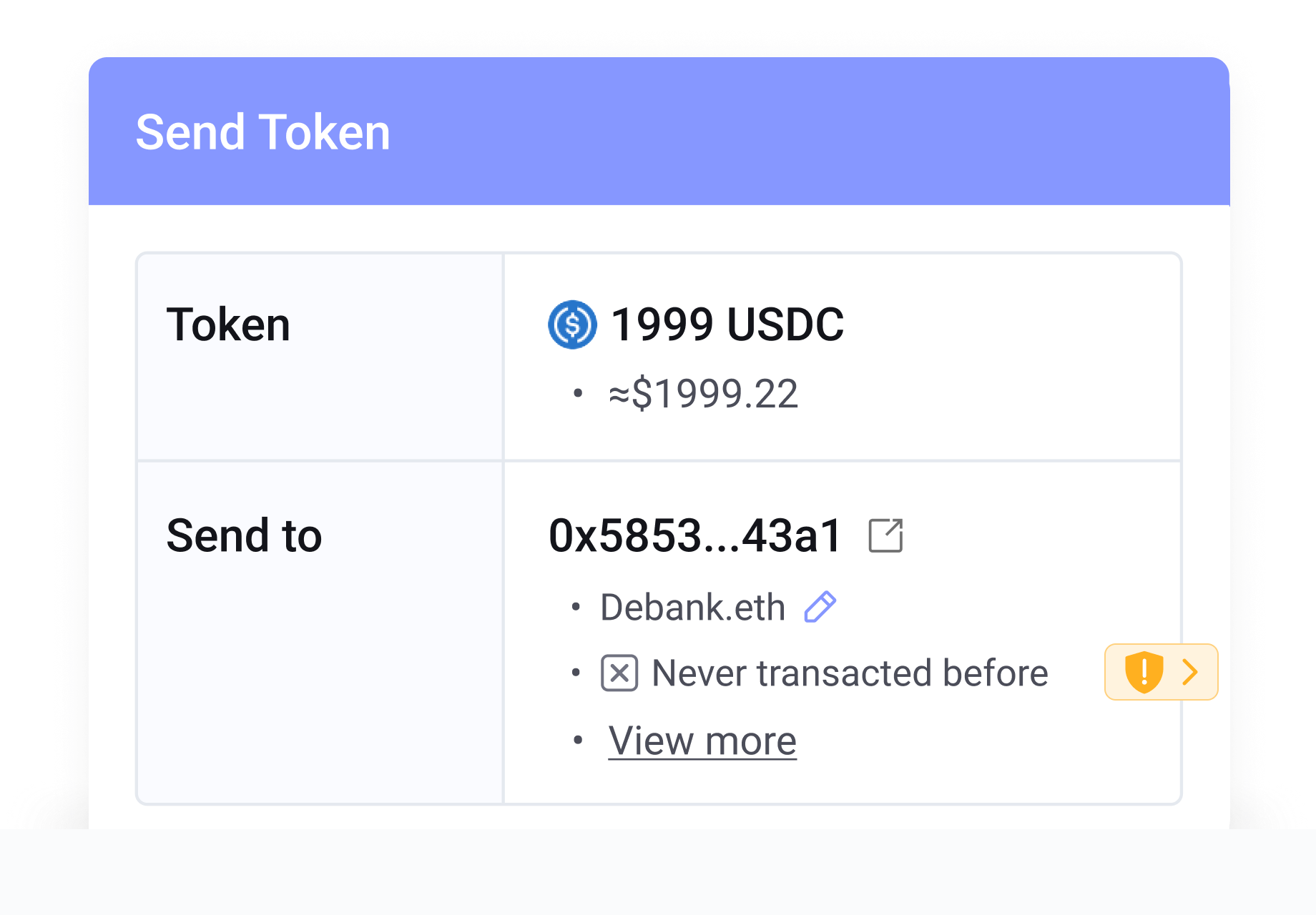
Transaction simulation — Rabby runs an off-chain simulation of a transaction before you sign. Mechanistically, the simulation estimates token balance changes and gas costs so you can see the intended outcome, reducing blind-signing. This matters because many wallet exploits rely on confusing or opaque transactions where the signer cannot see the effective movement of tokens. However, simulation is not perfect: it depends on model accuracy, up-to-date chain state, and the simulation environment. Fast front-running or reentrancy in live execution can still produce different results than the simulation.
Pre-transaction risk scanning — a built-in security engine flags previously hacked contracts, suspicious approval requests, or non-existent recipient addresses. This adds a pattern-recognition layer: contracts with a history of exploits or addresses impractical for human recipients get highlighted. The limitation is obvious — unknown, new malicious contracts won’t be flagged until they become known. The scan reduces false negatives over time but cannot guarantee safety against freshly deployed exploit contracts.
Approval revocation — Rabby exposes active token approvals and allows in-wallet cancellation. This reduces the long tail of exposure created by infinite allowances granted across many dApps. The trade-off: frequent revocations are operationally burdensome and can increase transaction costs; some DApps expect permissions to persist to provide a smoother user experience. Institutional setups usually keep fewer long-lived approvals and rely on multi-sig governance instead.
Where Rabby is strong — and where processes must fill gaps
Rabby brings real defensive value for DeFi power users in three practical scenarios:
– Complex multi-hop trades: simulation reveals exact effect on holdings and fees, reducing surprises.
– Managing approvals for many dApps: revocation reduces lingering attack surface.
– Cross-chain operations: automatic network switching and cross-chain gas top-up lower human error when shifting between EVMs.
But there are clear boundaries. Rabby does not provide a fiat on-ramp, so buying crypto still requires trusted third parties or exchanges. It lacks native staking within the wallet (at the time of writing), so staking workflows still require external interfaces or smart contracts. Importantly, Rabby’s security features cannot substitute for good key management: if an attacker obtains your seed phrase or your hardware wallet is compromised, pre-transaction simulations and scans won’t help. This is a causation distinction: product controls lower the probability of signing a malicious transaction; they do not causally prevent the upstream root cause of key compromise.
Past incidents show the limits of partial protections. In 2022 a Rabby-associated swap contract was exploited for roughly $190k. The team froze the contract and compensated users, and they subsequently tightened audits. That episode demonstrates two things: first, even security-first wallets can be affected by vulnerabilities in smart contracts integrated with them; second, responsive incident management and compensation matter operationally. For a power user, the practical takeaway is to combine Rabby’s protections with process: small, monitored exposure amounts, staged approvals, and test transactions for new contracts remain sensible.
Institutional and hardware integrations — raising the bar but not eliminating risk
For higher value or institutional funds, Rabby’s integrations with Gnosis Safe, Fireblocks, Amber, and Cobo Wallet are meaningful. Multi-signature (multi-sig) controls materially change the attack model: a single compromised key no longer suffices to move funds. Mechanistically, multi-sig enforces distributed authorization, which reduces single-point failures and insider risk. However, it introduces operational complexity: signing workflows, governance processes, and recovery procedures must be disciplined and auditable.
Hardware wallet compatibility (Ledger, Trezor, Keystone, and others) combines Rabby’s UX and simulation features with stronger key custody. This is a concrete risk reduction: private keys remain in hardware, and Rabby acts as a transaction proposer and inspector. Caveat: hardware wallets are not invulnerable — supply-chain risks, host machine compromise, or firmware vulnerabilities are plausible threats. The right defense-in-depth approach pairs hardware keys with segregated, up-to-date machines and limited-time approvals for high-value operations.
Decision framework: when to use Rabby as your primary wallet
Here is a short heuristic for choosing Rabby as your go-to wallet:
Use Rabby as primary if:
– You actively interact with many dApps across EVM chains and need automatic network switching.
– You require transaction previews and value the ability to revoke approvals quickly.
– You plan to integrate hardware wallets or multi-sig for higher-value accounts.
Consider alternatives or hybrid approaches if:
– You need fiat on-ramps directly in-wallet (Rabby lacks this).
– Your workflow depends on native in-wallet staking features.
– You prefer a single vendor-managed custody solution for regulatory or accounting reasons.
In practice, many power users run a hybrid stack: a hardware-backed Rabby profile for protocol interactions, a custodial exchange account for fiat rails and quick on-ramps, and a read-only portfolio tracker for audit and tax visibility.
What to watch next — signals and near-term implications
Monitor three things that will change the wallet threat landscape and Rabby’s comparative value: (1) improvements in on-chain simulation fidelity and oracle designs that shrink the gap between simulated and executed state; (2) broader adoption of multi-sig and institutional custody for DeFi protocols, which will increase demand for wallets that integrate these systems; and (3) any changes in regulatory posture in the US around self-custody, which could shift user behavior toward custodial intermediaries or increase pressure on wallet UX for compliance features.
None of these are certainties. Accurate simulation, for example, depends on how quickly relays and mempools evolve to produce front-running or MEV effects; stronger simulation reduces blind-signing risk but cannot eliminate live-chain race conditions. The prudent user watches feature roadmaps and incident post-mortems and adjusts operational controls rather than assuming a feature is a silver bullet.
FAQ
Is Rabby safe to install on my daily browser for trading?
Rabby includes security-focused features — transaction simulation, pre-transaction risk scanning, approval revocation, and automatic network switching — that lower the risk of accidental or blind-signing. For high-value activity, treat Rabby as one layer in a defense-in-depth strategy: use hardware wallets, keep a separate browser profile for trading, and avoid importing seed phrases on internet-connected machines unless absolutely necessary.
Can Rabby prevent all smart contract exploits?
No. Rabby reduces exposure by flagging known malicious contracts and simulating transactions, but novel vulnerabilities in smart contracts or in protocol logic can still be exploited. The wallet helps you avoid common user-side mistakes, but it cannot fix bugs in third-party smart contracts or prevent sophisticated on-chain manipulation.
Does Rabby support Ledger and other hardware wallets?
Yes — Rabby offers broad hardware wallet integration with devices like Ledger, Trezor, Keystone, and others. Combining hardware wallets with Rabby’s simulation gives a stronger custody posture: Rabby presents the transaction for review while keys remain in the hardware device.
How should I manage token approvals with Rabby?
Use Rabby’s approval revocation tool to audit allowances periodically. A practical rule: avoid infinite approvals where possible; for recurring trusted contracts consider time-limited allowances and revoke approvals after inactivity. Balance is required: revoking too aggressively increases gas costs and UX friction.
Final takeaway: Rabby packages meaningful technical mechanisms that reduce specific classes of user risk — especially blind-signing and long-lived approvals — and integrates well with hardware and multi-sig setups. For a US-based DeFi power user, that combination is decision-useful: Rabby lowers operational friction while making explicit the residual risks that still require disciplined custody, limited exposure, and careful contract vetting. No wallet is a substitute for process; Rabby is a tool that improves the chance that your processes will work when you need them most.